Rethinking traditional markers of success: Why young Thais now prioritise financial security and health over marriage and moving out
In the past, the idea of a successful life was often tied to a clearly defined sequence of social milestones: securing a stable job, getting married and starting a family, or establishing independence by moving out of the parental home.
For today’s younger generation, those definitions are changing. Young people are no less ambitious. They are reassessing their priorities and focusing first on building security in their own lives before pursuing the milestones traditionally set by society.
This changing definition of success is reflected in the British Council’s latest global research report, Next Generation Thailand. The study explores the views, aspirations and experiences of Thai young people aged 18 to 30 through a nationally representative survey of 2,000 respondents, alongside qualitative research and consultations with stakeholders across sectors.
Research findings: High ambition, but limited opportunities to participate
Sarah Rogerson, Country Director of the British Council Thailand, said the Next Generation programme has been conducted in more than 20 countries worldwide to better understand young people’s perspectives and priorities, and to bring their voices into policy development and future-focused partnerships.
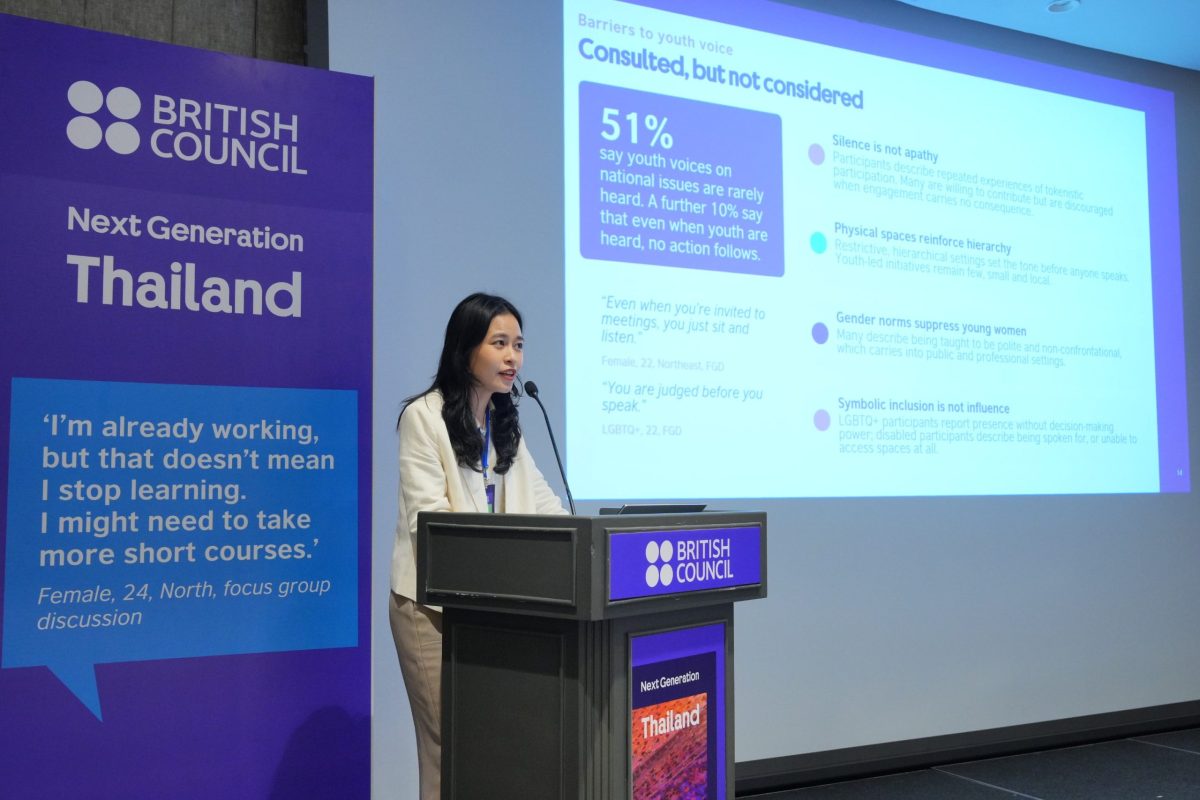
In Thailand, the findings portray a generation with strong ambition and a readiness to shape its own future. At the same time, young people continue to face economic constraints, gaps in education and skills, and limited opportunities to participate. Around half feel that young people’s voices on national issues are rarely heard, revealing an ‘Agency Gap’ between their capabilities, their desire to participate and the opportunities available to them in practice.
The British Council will therefore continue working with partners across English language, education, the arts and creative industries to create opportunities and spaces where young people can develop their potential and play a meaningful role in shaping their own futures and society.
A closer look at changing definitions of success: Security comes first
Presenting the report’s key findings, Piyatida Khambunma, Founder and Research Lead at Iconic Research, noted that young Thais remain highly ambitious, but define success differently from previous generations.
1.Building a foundation: Financial security at 62% and good health and wellbeing at 43%
The survey found that financial security is one of the most important markers of success for Thai youth, cited by 62% of respondents, followed by good health and wellbeing at 43%. Traditional social milestones carried significantly less weight.
These figures do not suggest that young people have fewer goals. On the contrary, 84% are optimistic about their career prospects and quality of life, while 68% are interested in starting a business within the next five years. The findings point to strong ambition and a desire to build their own futures. What has changed is the route to success: young people increasingly prioritise a secure foundation over following a prescribed set of social milestones.
This shift also reflects the wider Thai context. The Office of the National Economic and Social Development Council has previously discussed the phenomenon of ‘waithood’, in which people delay relationships or marriage because they do not yet feel economically secure or ready. Marriage before achieving that stability may be seen as adding financial pressure or limiting other opportunities in life.
Against a backdrop of economic uncertainty and rising living costs, young people appear to be strengthening the foundations of their lives, financially, physically and emotionally, before moving towards other goals.
2.Traditional social milestones are no longer the only measure of success
The contrast becomes even clearer when looking at milestones once widely regarded as signs of having fully entered adulthood.
Only 10% of Thai youth identified getting married or having a stable relationship as an important marker of success, while just 5% placed importance on moving out of their parents’ home.
This does not mean that young Thais reject marriage or have no wish to leave the family home. Rather, these milestones carry less weight as measures of a successful life than they did in the past.
Thailand’s marriage registration figures offer further context. Data from the National Statistical Office, sourced from the Department of Provincial Administration under the Ministry of Interior, show that registered marriages nationwide declined from 305,487 couples in 2022 to 279,748 in 2023 and 263,087 in 2024.
The decline cannot be attributed solely to young people’s changing definition of success. Considered alongside the survey findings, however, it provides useful evidence of changing life patterns and priorities among younger Thais.
Young people are not dreaming less. They are changing how they pursue their goals
Next Generation Thailand does not depict a generation turning away from marriage, family or home ownership. It shows young people reconsidering what meaningful success looks like in their own lives.
They remain ambitious, optimistic about the future and determined to shape their own paths. At the same time, they are placing greater emphasis on financial security, health and quality of life before pursuing other milestones.
This is more than a change in values. It reflects a reordering of life priorities in response to changing economic and social conditions.
A new challenge for government, education and business
The more useful question is not why young people are no longer following a traditional path, but how society can create the conditions that allow them to turn ambition into genuine opportunity.
The findings send an important message to government, education providers, businesses and organisations working with young people. Supporting the next generation does not mean directing them towards the same definition of success followed by previous generations. It means creating an enabling ecosystem in which they can build security and determine their own paths.
This includes developing skills for the future labour market, widening access to education and English language learning, supporting entrepreneurship, and creating meaningful opportunities for young people to participate in decisions that affect their future.
When young people have security, opportunity and room to use their capabilities, their existing ambition can become a powerful force in shaping Thailand’s future.
Download the full Next Generation Thailand report from the British Council website: https://www.britishcouncil.org/research-insight/next-generation-thailand